
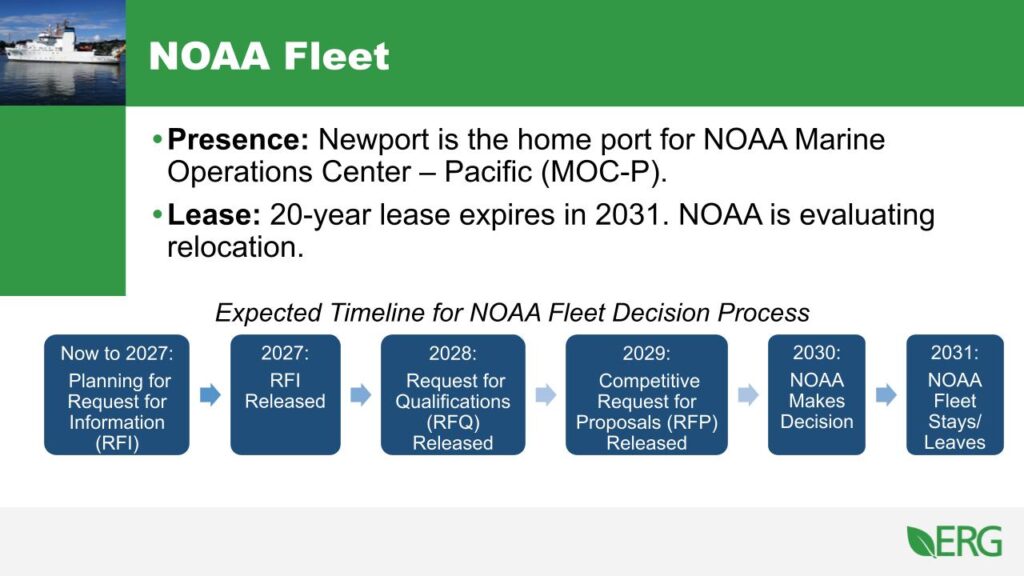
Funded by Congressionally Directed Spending dollars allocated by the Economic Development Alliance of Lincoln County in preparation for the anticipated Request for Information, the 2024 report on the economic impact of NOAA’s Marine Operations Center–Pacific (MOC-P) underscores just how central the federal fleet is to Oregon’s blue economy. Since relocating to Newport in 2011, the NOAA fleet has anchored not only ship operations but also a wide network of scientific, technical, and logistical services across the state. The findings are stark: if NOAA were to relocate when its lease expires in 2031, Oregon could face the loss of nearly 900 jobs, $273 million in annual economic output, and close to $8 million in state and local tax revenues.
For Lincoln County, where the fleet is based, the potential disruption is more acute. The report estimates a loss of 620 jobs—representing about 2.3% of the county’s workforce—and more than $211 million in annual output. To put this into perspective, the projected contraction in county GDP from a fleet departure would be roughly three times greater than the downturn caused by COVID-19. Local industries most directly tied to NOAA’s operations (ship repair, marine science services, and professional contracting) would be hit hardest. Real estate, both residential and commercial, would also see significant declines as NOAA families and related businesses leave the area.
At the state level, while the direct impacts are smaller, the ripple effects are broad. Industries in Portland and elsewhere supply critical technical services to NOAA vessels, from engineering to IT support. Indirect and induced impacts would be felt in sectors ranging from management services to hospitals. Importantly, the report highlights that NOAA employees earn well above Oregon’s median wage, meaning their departure would reverberate through housing markets, schools, and consumer spending well beyond Newport.
The broader significance of this analysis is the need to develop and diversify Oregon’s emerging blue economy. Newport has cultivated a reputation as a marine science hub, home to OSU’s Hatfield Marine Science Center, commercial fishing fleets, and a cluster of ocean research organizations. NOAA’s presence has been central to that identity, both symbolically and economically. Without it, Oregon risks losing momentum in building a globally competitive marine research and innovation ecosystem. Conversely, securing NOAA’s long-term presence could strengthen Oregon’s position as a leader in ocean science, resilience, and sustainable maritime industries.
In short, the report is both a wake-up call and an opportunity. Policymakers, port authorities, and industry leaders have begun working to address an important question in the coming years: How do we retain NOAA in Newport while leveraging its presence to grow Oregon’s blue economy? Failure to act could unravel years of investment and hard-won reputation. Success, however, would anchor Oregon’s coast as a hub of science-driven maritime innovation well into the future.
Read the full report here.